More results...

  • Cart
  • Checkout

Claire Givens Violins, Inc

Dealers, Makers & Restorers of Fine Violins, Violas, Cellos & Bows

  • Instrument Collection
        • VIOLINS

          • Up to $1,000
          • $1,001 – $2,000
          • $2,001 – $4,000
          • $4,001 – $8,000
          • $8,001 – $12,000
          • $12,001 – $20,000
          • $20,001 – $40,000
          • $40,001 – $60,000
          • $60,001 – $100,000
          • Over $100,001
          • Popular Student Violins
          • Small Violins
        • VIOLAS

          • Up to $1,000
          • $1,001 – $2,000
          • $2,001 – $4,000
          • $4,001 – $8,000
          • $8,001 – $12,000
          • $12,001 – $20,000
          • $20,001 – $40,000
          • $40,001 – $60,000
          • $60,001 – $100,000
          • Over $100,001
          • Popular Student Violas
          • Small Violas
        • CELLOS

          • Up to $2,000
          • $2,001 – $3,500
          • $3,501 – $5,000
          • $5,001 – $8,000
          • $8,001 – $12,000
          • $12,001 – $25,000
          • $25,001 – $50,000
          • $50,001 – $100,000
          • Over $100,001
          • Popular Student Violas
          • Small Violas
  • Bow Collection
        • Violin Bows

          • Up to $300
          • $301 – $600
          • $601 – $1,000
          • $1,001 – $1,500
          • $1,501 – $2,500
          • $2,501 – $5,000
          • $10,001 – $20,000
          • Over $20,001
          • Small Violin Bows
        • Viola Bows

          • Up to $300
          • $301 – $600
          • $601 – $1000
          • $1,001 – $1,500
          • $1,501 – $2,500
          • $2,501 – $5,000
          • $5,001 – $10,000
          • $10,001 – $20,000
          • Over $20,001
          • Small Viola Bows
        • Cello Bows

          • Up to $300
          • $301 – $600
          • $601 – $1,000
          • $1,001 – $1,500
          • $1,501 – $2,500
          • $2,501 – $5,000
          • $5,001 – $10,000
          • $10,001 – $20,000
          • Over $20,001
          • Small Cello Bows
  • Workshop
        • Under the long-time expertise and leadership of Workshop Manager Douglas Lay, the Givens Violins Workshop is staffed by a team of professionally trained violin makers and a full-time Bow Specialist. Our mission is to assist players in obtaining the best sound and response from their instruments and their bows. We encourage you to call us at 612 – 375 -0708 or e-mail us at workshop@givensviolins.com to discuss any questions you may have and to make an appointment. The workshop provides estimates of work needed and maintains a weekly schedule, upholding a reputation for careful, thorough, and high-quality restorations.
        • About The Team

          Meet Doug Lay, Workshop Manager

          Meet Kim Spagnola, Bow Restorer

        • WorkShop

          About the Workshop

          Instrument & Bow Checkups

  • Dipper Early Instruments & Bows
        • DIPPER EARLY INSTRUMENTS & BOWS

          Early Violins

          Early Violas

          Early Cellos 

        • DIPPER RESTORATIONS WEBSITE

          Dipper Restorations Website

        • MEET THE DIPPER STAFF

          Meet The Dipper Staff

        • BAROQUE BOWS

          Baroque Violin Bows

          Baroque Viola Bows

          Baroque Cello Bows

        • CLASSICAL BOWS

          Classical Viola Bows

          Baroque Cello Bows 

          Baroque Cello Bows 

        • POPULAR DIPPER RESTORATIONS BLOGS

          Andrew Dipper Early Bow Models

          Andrew Dipper Early Instrument Restorations

          Getting Started in Early Music

          Historical Instruments & Bows

          Historical Maker Profiles

          “Dear Mr. Puppy” Column

  • Products
        • We carry a wide variety of accessories including strings, mutes, shoulder rests, chin rests, metronomes, music stands, and more. Our string prices are the lowest on the market. Accessories are easily shipped upon request. To make a purchase, please contact us today (link) or stop by our shop, 10am – 5pm, Tuesday - Saturday.
        • Cases

          Books

          Featured Accessories

  • Services
        • As a full-service string shop, Givens Violins offers a wide range of services to our clients through every step of the instrument selection process and throughout your playing career.
        • Trial-Program
          Trade-In Policy
          Financing
          Teacher Gift Card Program

        • Appraisals & Consignment
          Shipping
          Warranty
          Return Policy

  • About Us
    • Meet The Staff
    • Testimonials
    • Community Support
  • Resources
        • Resources

          Instrument Insurance

          Industry Links 

          The Anatomy of a Violin

          The Anatomy of a Bow

          String Instrument Maintenance Guide

          La Voce Newsletter Archives (1997-2009)

        • GIVENS VIOLINS BLOG 

          Advice for New Players, Parents and Students

          Instrument Care & Keeping

          Spotlights on Important Current & Historical Makers

          Interviews with Staff & Professional Musicians

          Humor & History

  • Contact us

More results...

January 3, 2014 by Alan Burke

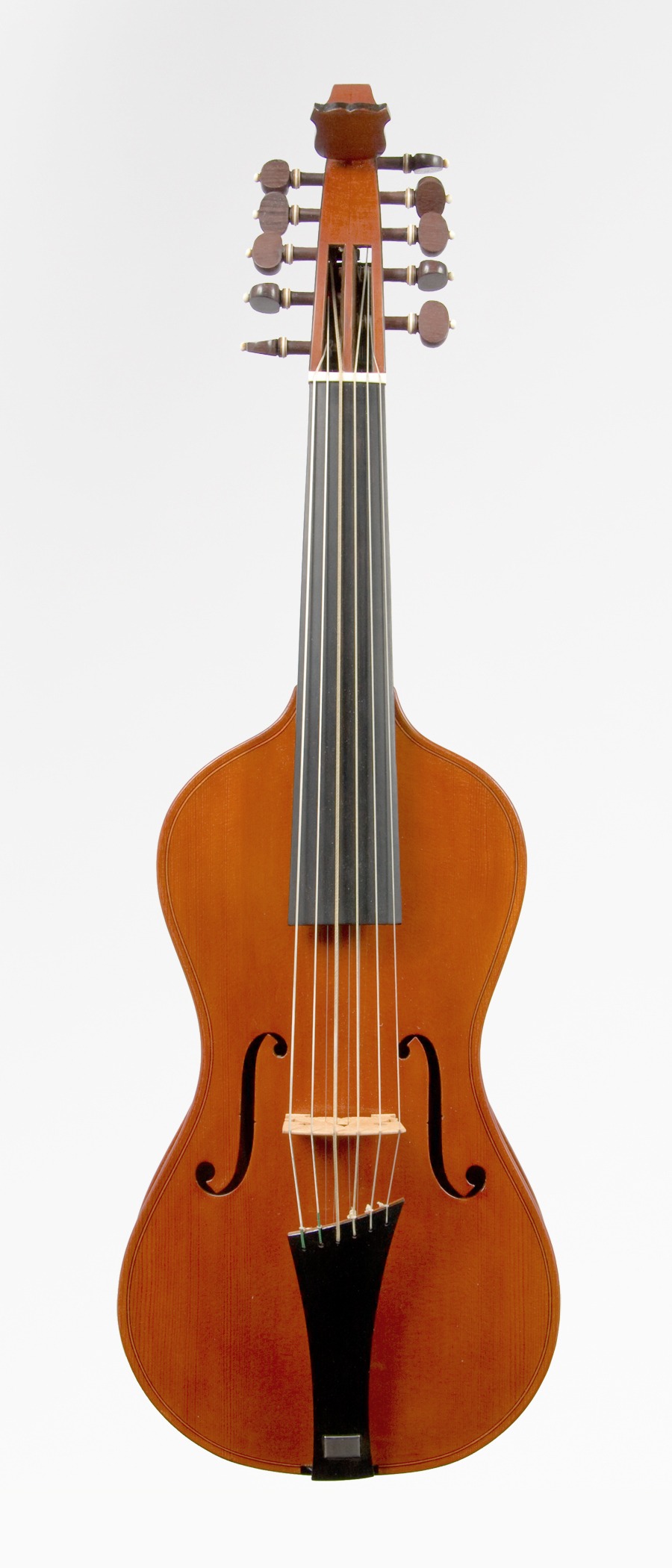
Andrew Dipper Viola D'Amore Front

Andrew Dipper Viola D’Amore Front

I started building the instrument in 2001, but because of the restoration demands of the workshop it was not finished until 2008. The wood for the instrument came from three sources. For the belly I chose a very old piece of Baltic spruce that came from England. It was once part of a cupboard shelf in an eighteenth century house. I chose it because of its age and for its perfect grain.

The bird’s-eye maple for the back and ribs came from a fifty year old board from the USA, donated by the composer Carol Barnett, whose father had collected it many years ago. The neck was carved in apple wood because it is strong enough to take the pressure of the peg arrangement in the three wall peg box of the viola d’amore without cracking between the closely spaced holes of the central wall. The first step in the whole process was making the mould and working out the exact procedure that the Stradivari workshop had used for the assembly of these instruments. To aid in the making process I remade a tool called a platen, which is an apparatus separate but integral to the mould. This is used to both facilitate the construction of the instrument and aid the correct inclination of the neck and its alignment. With a corner-less form the waist of the instrument has to be pulled tight to the mould with the aid of a gut string that passes through a hole in the center of each rib face. The viola d’amore ribs were constructed on the mould and then placed on the platen once the neck was nailed in place, as was the practice in the 1700’s. Once the neck was aligned the back was glued in place and fixed there with the aid of two small fruitwood pins. In this system once the back is glued in place it fixes everything rigid according to plan. Previous to the back being glued in place the sound bars were attached to it together with the post plate. Since the viola was made in the USA I chose a barring scheme used by Joachim Tielke. This scheme uses an oval spruce post plate whose grain is in line with the grain of the back of the instrument. It has stiffening tabs that radiate out from it making it more stable in the North American climate than the transverse design usually used by viol makers. This ordinary form post plate tends to block the summer and winter movement of the back, which leads to instability, distortion and cracking.
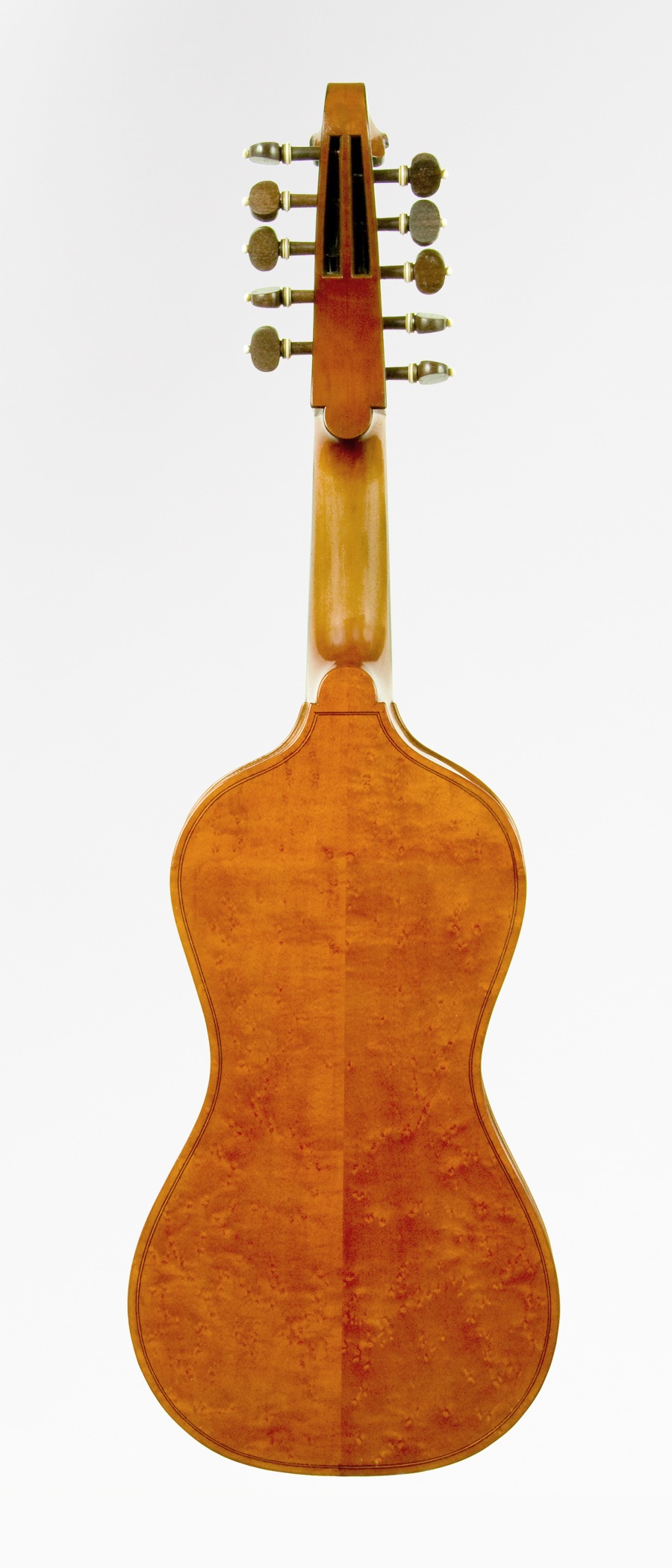
Andrew Dipper Viola D'Amore back

Andrew Dipper Viola D’Amore back

The construction was fairly easy and the only problem was deciding on the plate thicknesses and their graduations. In the end I chose the early Stradivari scheme where the center of the belly has a marginally thicker strip running the uninterrupted length of the belly between the ff holes. The fingerboard was made from ebony veneered maple and the tailpiece from ebony veneered apple wood.

I also decided at this point since the neck was wide enough for six strings that I would reassign the strings so that six playing strings would run over the fingerboard and four sympathetic would run under the fingerboard.  Finally I analyzed the bridge model that was part of the original set of Stradivari papers and realized that it too was designed using a proportional scheme that uses the intersection of a nine division base line with a seven division vertical line. (See illustration.)  I hand-turned the pegs, using an original Italian model in rosewood with bone rings and pips.

The instrument was displayed in Cremona  in 2008 for the exhibition “E furono liutai in Cremona. Dal Rinascimento al Romanticismo.  It was enthusiastically received by the Cremonese makers who were fascinated by the possibilities inherent in the design.

The sound of the instrument was very successful.  Its playing characteristics are a full, rich, reedy tone, with the underlying Stradivari sizzle that makes his instruments so characteristic.


Andrew Dipper


Filed Under: Andrew Dipper’s Restoration Work

Contact

1201 Marquette Ave. Suite 150
Minneapolis, Minnesota 55403
Directions

Phone: 612-375-0708 or
800-279-4323
Fax: 612-375-0096
cgivens@givensviolins.com

Contact Us

Connect With Givens

Sign up for our Newsletter

Select list(s) to subscribe to

Hours

Tuesday – Saturday
10:00 a.m. – 5:00 p.m.

612/375-0708 

Parking

Parking is available at: The Plaza Ramp and the Hilton Hotel Ramp (11th Underground Ramp). Click here for details.

Quick Links

Job Opportunities

Our Mission

Site Map

FAQS


Translate Our Site

Sphinx Partnership

Givens Violins is a proud Partner of the Sphinx Organization!- Transforming lives through diversifying the arts.

Our Affiliations

Accessibility Statement

Review us on : Google

Claire Givens Violins Inc. © 2026
Developed by EMOD, LLC
  • Home
  • Directions
  • Parking
  • Blog
  • oldContact Us
  • Workshop
  • Services
    • Trial Program
    • Trade-In Policy
    • Appraisals
    • Consignment
    • Instrument & Bow Checkups
    • Accessories
    • Teacher Gift Program
    • Financing
    • Shipping
    • Warranty
    • Return Policy
  • About Us
    • Workshop
    • Meet The Staff
    • Testimonials
    • Community Support
    • Our Mission
    • Job Opportunities
  • Resources
    • Insurance
    • Industry Links
    • String Instrument Maintenance Guide
    • The Anatomy of the Violin – Learn about the different parts of the violin
    • Anatomy of a Bow – The Ultimate Guide to Violin Bows
    • Blog
    • FAQs
    • La Voce Newsletters
    • Sitemap
  • Inventory
    • Violins
    • Violas
    • Cellos
    • Violin Bows
    • Viola Bows
    • Cello Bows
    • Small Instruments
    • Small Bows
    • Early Instruments & Bows
    • Books
    • Cases
  • Dipper Restorations
    • Inventory
      • Early Instruments & Bows
        • Early Instruments
          • Violins
          • Violas
          • Cellos
        • Early Bows
          • Violin Bows
          • Viola Bows
          • Cello Bows
          • Bass bows
    • Dipper Restoration Staff
    • Projects
    • Links
    • Popular Dipper Restoration Blogs
      • Mr Puppy blog
      • Restoration Blog
      • Bow Model Blogs
  • Cart
    • Checkout

×

Please inquire about pricing

Thank you for your inquiry. We will contact you shortly.