More results...

  • Cart
  • Checkout

Claire Givens Violins, Inc

Dealers, Makers & Restorers of Fine Violins, Violas, Cellos & Bows

  • About Us
    • Workshop
    • Meet The Staff
    • Testimonials
    • Community Support
    • Our Mission
    • Job Opportunities
    • Privacy Guidelines
  • Inventory
    • Violins
    • Violas
    • Cellos
    • Violin Bows
    • Viola Bows
    • Cello Bows
    • Small Instruments
    • Small Bows
    • Early Instruments & Bows
      • Early Instruments
        • Violins
        • Violas
        • Cellos
      • Early Bows
        • Violin Bows
        • Viola Bows
        • Cello Bows
        • Bass Bows
    • Books
    • CDs
    • Cases
  • Services
    • V. Richelieu Fractional Viola Rental Program
    • Trial Program
    • Trade-In Policy
    • Appraisals
    • Consignment
    • Instrument & Bow Checkups
    • Accessories
    • Teacher Gift Program
    • Financing
    • Shipping
    • Warranty
    • Return Policy
  • Resources
    • Renting Vs. Buying Your First Violin, Viola, or Cello
    • Survive the cold: 5 winter care tips for protecting your string instrument
    • The New Season begins – A Checklist for Professionals
    • BACK TO SCHOOL: Preparing for Back-to-School Music Lessons and Orchestra
    • Industry Links
    • Insurance
    • String Instrument Maintenance Guide
    • The Anatomy of the Violin – Learn about the different parts of the violin
    • Anatomy of a Bow – The Ultimate Guide to Violin Bows
    • News
    • FAQs
    • La Voce Newsletters
    • Sitemap
  • Dipper Restorations
    • Inventory
      • Early Instruments
        • Violins
        • Violas
        • Cellos
      • Early Bows
        • Violin Bows
        • Viola Bows
        • Cello Bows
        • Bass Bows
    • Dipper Restoration Staff
    • Projects
    • Links
    • Popular Dipper Restoration Blogs
      • Mr Puppy blog
      • Restoration Blog
      • Bow Model Blogs
    • Contact Dipper Restorations
    • Boston Early Music Festival (BEMF) 2025
  • Contact
    • Directions
    • Parking
  • Blog

the fine art of restoring, conserving, and building historic musical instruments

More results...

What Did They Play?

November 24, 2018 by Sherry

What Did They Play? by Isabel Dammann

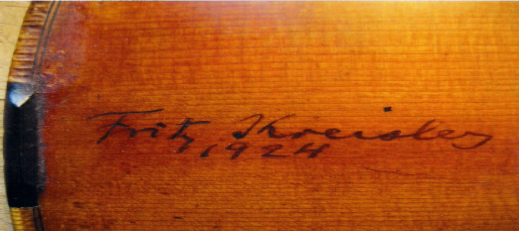
PART I: Fritz Kreisler (b. 1875 – d. 1962) and his Violins

“The violinist should not be accused of inconstancy; he must follow the call of a siren voice – the voice of the magic piece of wood that dominates his destiny. It is the voice of an enchantress which he must obey.” -Fritz Kreisler, 1908[1]

Many musicians have a primary instrument they play that becomes synonymous with their musical voice – Fritz Kreisler was not one of these musicians. Throughout his life as a performer, Kreisler bought, played and sold dozens of instruments, including numerous Stradivari and Guarneri violins. Some became favorites, while others were merely visitors in his collection.

As a young child, Fritz Kreisler listened to his father play violin in an amateur string quartet. Wanting to participate, he made himself a toy violin, and he’d pretend to play during their rehearsals: “Soon I made myself a would-be violin out of a cigar box over which I stretched shoe strings; and I’d pretend I was playing right…”[2] Noticing his keen interest in the instrument, Kreisler’s father got him a small violin and bow and began to give him lessons. By age eight, Kreisler was given a half-sized Thir violin from the Vienna Conservatory, and at age ten he won a ¾-sized Amati as first prize in the Austrian State competition. As a 13-year-old, Kreisler won 1st prize at the Paris Conservatorie, and was gifted a full-size Gand-Bernadel as well leant the c. 1708 “Davidov” Stradivarius. Upon returning home, Kreisler’s father gave him a beautiful Giovanni Grancino violin that he played for eight years.

One morning, Kreisler visited an old architect friend in Vienna, who said, “Fritz, here is an old, battered violin that you can have, perhaps make some use of, by giving it away to someone who needs it.” Upon returning home, Kreisler realized it was a genuine Nicol Gagliano, “of entrancing tone and quality”. As Kreisler recalls, “It became the best beloved of my violins until within three years ago. It traveled with me on my concert tours in almost every large city in Europe and America.”[3]

Around the turn of the century, Kreisler bought the c. 1735 ‘Mary Portman’ Guarneri del Gesu from the dealer George Hart for only $10,000. It was not long, however, before another instrument stole Kreisler’s affections: the c. 1734 ‘Hart’ Guarneri del Gesu (now referred to as the ‘Hart, Kreisler c. 1734’), then owned by the collector John Adams. Kreisler recalls:

Then one day as I entered the rooms of Mr. Hart I heard a Voice, liquid, pure, penetrating, whose divine sweetness pierced my soul as a knife with the anguish of longing…That this divine Voice should be doomed to silence under the glass case of a collector was to me a tragedy that rent my heart… Finally he took it from his case, saying, ‘Play’ … When I had finished, he said: ‘I have no right to it; keep it; it belongs to you. Go out into the world and let it be heard’… This time I shall be faithful until the end, for I do not delude myself that I shall ever hear a voice more beautiful than that of my last beloved, my ‘Hart’ Guarnerius.[4]

It is likely that Fritz Kreisler played this violin for his first five recordings in Berlin in 1904, as well as using it for recordings he made in New York and London between 1910-1916. He premiered the Elgar Concerto on this instrument in 1910 and sold it in 1917[5].

In 1908, Kreisler bought the c. 1726 ‘Greville’ Stradivarius from Kempton Adams, who prepared a detailed brochure especially for Kreisler about the instrument. However, he only had it for a year or two before selling it to Lyon & Healy of Chicago. Around this time, Kreisler also purchased the c. 1732 Guarneri del Gesu, as well as the c. 1733 Stradivari known as the ‘Huberman, Kreisler’ from Alfred Hill, which quickly became his new favorite. Kreisler played the ‘Huberman, Kreisler’ Strad on his 1926-1927 concerto recordings (Brahms, Mendelssohn, and Beethoven) with the Berlin State Opera Orchestra conducted by Leo Blech, and his 1928 sonatas with Sergei Rachmaninoff on piano. Hill bought the violin back in 1936 and shortly after sold it to Bronislaw Huberman[6].

“Hill offered me some fine instrument from time to time and suggested that I take it home and even use it for concert purposes. As I like to give my violins a rest, I gladly accepted the offer. No sooner had I used such an instrument in a public performance, however, than Hill was able to sell it for a much higher price because somehow the impression got around that I liked it so much that I even preferred it to my own violin.” -Fritz Kreisler[7]
(To be continued…)

[1] Louis P. Lochner, Kreisler (Neptune City, NJ: Paganiniana Publications, Inc), 349.

[2] Tully Potter, “Kreisler’s Violins,” Tarisio, February 1st 2017, https://tarisio.com/cozio-archive/cozio-carteggio/kreislers-violins/

[3] Lochner, Kreisler, 349.

[4] Lochner, Kreisler, 350.

[5] Potter.

[6] Ibid.

[7] Lochner, Kreisler, 351
Filed Under: Humor & History

String Theory: Historical Facts About Your Violin Strings

November 2, 2017 by Givens Violins

String Theory: Historical Facts About Your Violin Strings

Violin stringsAs musicians, we are constantly in search for information regarding the music we play and our instruments. Many of us are aware that violin strings were once made out of gut, but perhaps you didn’t realize that gut was the standard material used until after World War II. Evidence found in ancient Egyptian hieroglyphics suggest that the production of strings made of sheep gut spans back some 6,000 years. It would require an entire book to divulge every detail of string history, but here are several key points on the history of violin strings.

The G String

  1. As with other strings, the G string began as a pure gut string. By the late 1600s, G strings were wound with silver or copper wire to produce a fuller, resonating sound.
  2. The sound of wound G strings was clearly superior to that of pure gut, and by the 1730s pure gut had been totally replaced by wound gut.

The D String

  1. Pure gut D strings were the standard until end of the First World War. In times past the technology needed to produce wire thin enough to wind the string simply didn’t exist.
  2. In 18th Century France, a method called demi-filée (half-wound) was developed, which applied the wire to the core of the string. This solution resulted in very thick D strings and never became widespread, vanishing completely by the end of that century.
  3. The use of aluminum to fully wind gut D strings can be traced to the period after WWII.

The A String

  1. The A string was the last of the four strings to transition from pure to wound gut. Pirastro developed the first wound gut A string in 1951 using aluminum. It took nearly ten years before it became standard.
  2. The pure gut A string was common until the advent of synthetic strings in 1970.

The E String

  1. Due to their thin gauge, gut E strings were never wound, and pure gut E strings were common well into the twentieth century. The first steel E string appeared around 1910, but didn’t gain prominence until the Second World War when sheep gut became scarce.
  2. From the 1880s until the development of steel strings, silk strings were used as an alternative to gut, but usually only in the case of an emergency.

Strings as most of us know them today are made from synthetic materials and then wound in aluminum, chrome, steel, silver, or an alternative metal. Wound steel strings were long-lasting and not as sensitive to the climate as gut, however most players found them to have an undesirable metallic or ‘tinny’ quality. Synthetics present the best of both worlds: the warm timbre of gut combined with the reliability of steel. The first synthetics were developed by Thomastick-Infeld and released into the market in 1970, popularly known as Dominant.

Filed Under: Humor & History Tagged With: aluminum violin strings, gut strings, gut strings history, history of violin strings, silk violin strings, steel violin strings, synthetic violin strings, synthetic violin strings history, violin strings, violin strings history, when did violin strings become wound with metal, wound metal violin strings, wound violin strings

  • « Previous Page
  • 1
  • 2
  • 3
  • Next Page »

Resources

  • Insurance
  • Industry Links
  • String Instrument Maintenance Guide
  • The Anatomy of the Violin – Learn about the different parts of the violin
  • Anatomy of a Bow – The Ultimate Guide to Violin Bows
  • News
  • BACK TO SCHOOL: Preparing for Back-to-School Music Lessons and Orchestra
  • The New Season begins – A Checklist for Professionals
  • Blog
  • FAQs
  • La Voce Newsletters
  • Sitemap
  • Renting Vs. Buying Your First Violin, Viola, or Cello
  • V. Richelieu Fractional Viola Rental Program
  • New contact us
  • About Us
  • About Us
  • Instrument Care & Keeping
  • Getting Started in Early Music
  • Advice for New Players, Parents and Students
  • Historical Instruments & Bows
  • Spotlights on Important Current & Historical Makers
  • Interviews with Staff & Professional Musicians
  • Humor & History

Contact

1201 Marquette Ave. Suite 150
Minneapolis, Minnesota 55403
Directions

Phone: 612-375-0708 or
800-279-4323
Fax: 612-375-0096
cgivens@givensviolins.com

Contact Us

Connect With Givens

Sign up for our Newsletter

Select list(s) to subscribe to

Hours

Tuesday – Saturday
10:00 a.m. – 5:00 p.m.

612/375-0708 

Parking

Parking is available at: The Plaza Ramp and the Hilton Hotel Ramp (11th Underground Ramp). Click here for details.

Translate Our Site

Sphinx Partnership

Givens Violins is a proud Partner of the Sphinx Organization!- Transforming lives through diversifying the arts.

Our Affiliations

Accessibility Statement

Review us on : Google

Inventory

  • Violins
  • Violas
  • Cellos
  • Violin Bows
  • Viola Bows
  • Cello Bows
  • Small Instruments
  • Small Bows
  • Early Instruments & Bows
    • Early Instruments
    • Early bows
  • Books
  • CDs
  • Cases
  • Back-to-School Sale on Fractional Instruments and Bows!
  • V. Richelieu Fractional Viola Rental Program
  • New contact us
  • About Us
  • About Us
  • Instrument Care & Keeping
  • Getting Started in Early Music
  • Advice for New Players, Parents and Students
  • Historical Instruments & Bows
  • Spotlights on Important Current & Historical Makers
  • Interviews with Staff & Professional Musicians
  • Humor & History

About Us

  • Workshop
    • At the Workshop Bench: An Interview with Givens Violins’ Workshop Manager, Doug Lay
  • Meet The Staff
  • Dipper Restorations
  • Testimonials
  • Community Support
  • Our Mission
  • Job Opportunities
  • Privacy Guidelines

Services

  • Trial Program
  • Trade-In Policy
  • Appraisals
  • Consignment
  • Instrument & Bow Checkups
  • Accessories
  • Teacher Gift Program
  • Financing
  • Shipping
  • Warranty
  • Return Policy

Resources

  • Insurance
  • Industry Links
  • String Instrument Maintenance Guide
  • The Anatomy of the Violin – Learn about the different parts of the violin
  • Anatomy of a Bow – The Ultimate Guide to Violin Bows
  • News
  • BACK TO SCHOOL: Preparing for Back-to-School Music Lessons and Orchestra
  • The New Season begins – A Checklist for Professionals
  • Blog
  • FAQs
  • La Voce Newsletters
  • Sitemap
  • Renting Vs. Buying Your First Violin, Viola, or Cello
  • V. Richelieu Fractional Viola Rental Program
  • New contact us
  • About Us
  • About Us
  • Instrument Care & Keeping
  • Getting Started in Early Music
  • Advice for New Players, Parents and Students
  • Historical Instruments & Bows
  • Spotlights on Important Current & Historical Makers
  • Interviews with Staff & Professional Musicians
  • Humor & History
Claire Givens Violins Inc. © 2026
Developed by EMOD, LLC
  • Home
  • Directions
  • Parking
  • Blog
  • Contact Us
  • Workshop
  • Services
    • Trial Program
    • Trade-In Policy
    • Appraisals
    • Consignment
    • Instrument & Bow Checkups
    • Accessories
    • Teacher Gift Program
    • Financing
    • Shipping
    • Warranty
    • Return Policy
  • About Us
    • Workshop
    • Meet The Staff
    • Testimonials
    • Community Support
    • Our Mission
    • Job Opportunities
    • Privacy Guidelines
  • Resources
    • Insurance
    • Industry Links
    • String Instrument Maintenance Guide
    • The Anatomy of the Violin – Learn about the different parts of the violin
    • Anatomy of a Bow – The Ultimate Guide to Violin Bows
    • News
    • Blog
    • FAQs
    • La Voce Newsletters
    • Sitemap
  • Inventory
    • Violins
    • Violas
    • Cellos
    • Violin Bows
    • Viola Bows
    • Cello Bows
    • Small Instruments
    • Small Bows
    • Early Instruments & Bows
    • Books
    • CDs
    • Cases
  • Dipper Restorations
    • Inventory
      • Early Instruments & Bows
        • Early Instruments
          • Violins
          • Violas
          • Cellos
        • Early Bows
          • Violin Bows
          • Viola Bows
          • Cello Bows
          • Bass bows
    • Dipper Restoration Staff
    • Projects
    • Links
    • Popular Dipper Restoration Blogs
      • Mr Puppy blog
      • Restoration Blog
      • Bow Model Blogs
  • Cart
    • Checkout

×

Please inquire about pricing

Thank you for your inquiry. We will contact you shortly.